When Seconds Matter: How Safety Training Could Change the Outcome of Battery Fires
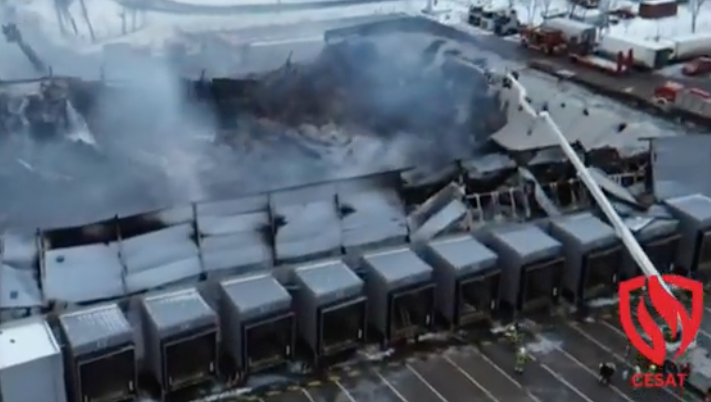
Lessons from the Recent Warehouse Fire in Poland
The recent lithium-ion battery fire in a logistics warehouse in western Poland offers an important and sobering lesson for all organizations involved in battery storage, transport, and handling. Beyond the scale of the damage—estimated by industry observers to exceed €100 million—this incident highlights a critical factor that is often underestimated: the role of safety training in buying time and guiding early decisions.
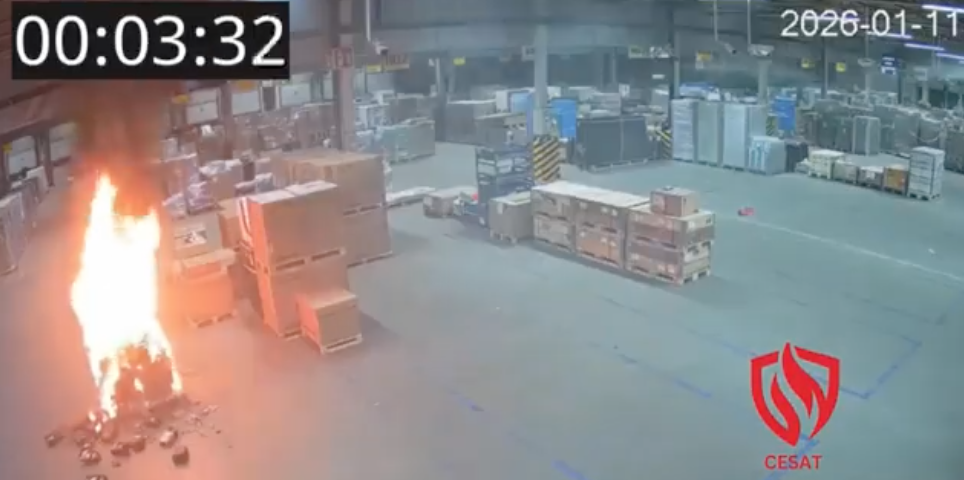
Tap Image to Watch CCTV Footage
CCTV footage from the incident shows a fire that initially appears controllable. Smoke develops, personnel intervene with portable extinguishers, and the situation seems manageable—until it suddenly is not. Within minutes, the fire escalates beyond the capability of manual response, ultimately overwhelming the facility.
Training Is Not About Blame — It Is About Time
There is no indication that staff or responding fire services acted improperly. On the contrary, their actions reflect what many trained workers would instinctively do when faced with a small, localized fire.
However, lithium-ion battery fires are fundamentally different from conventional combustibles. Effective safety training helps personnel recognize when a fire is no longer “small” in a technical sense, even if it still looks manageable visually.
Training does not eliminate risk—but it can:
- Shorten the time to recognize a battery-related event
- Improve early decision-making under uncertainty
- Reduce hesitation during the critical early minutes
In battery fire scenarios, delays of even a few minutes can determine whether escalation is prevented or inevitable.
Recognizing Battery Fire Indicators Early
One of the most valuable contributions of targeted battery safety training is teaching personnel to recognize early warning signs that differ from ordinary fires, such as:
- Rapid smoke generation disproportionate to visible flames
- Popping, hissing, or venting sounds from battery packs
- Persistent re-ignition despite extinguisher use
- Localized heat increase without clear flame spread
In the Poland incident, CCTV footage suggests that by the time these indicators were visible, the window for effective manual intervention may already have been closing.
Training as a Trigger for Escalation Protocols
Well-designed safety training does not simply teach “how to fight a fire.” More importantly, it defines when not to.
In lithium-ion battery environments, training should empower personnel to:
- Prioritize early evacuation over prolonged extinguisher use
- Activate emergency response protocols without delay
- Understand that extinguishers may cool or mask symptoms but not stop thermal runaway
- Recognize that persistence can increase personal risk without improving outcomes
Clear, rehearsed decision thresholds—reinforced through training—can prevent well-intentioned actions from inadvertently costing valuable time.
Training Complements Engineering Controls
Safety training is not a substitute for automatic detection or fixed suppression systems, such as sprinklers or water mist. However, training plays a critical role in ensuring that these systems are:
- Activated promptly
- Supported by appropriate human response
- Not relied upon as a last resort
In many facilities, the time gained by suppression systems is only fully effective when personnel understand how to respond during those early moments.
A Supply Chain–Wide Responsibility
The Poland fire also reinforces that lithium-ion battery risk exists throughout the entire logistics chain—from manufacturing and warehousing to transport and recycling. Training must therefore extend beyond specialized battery facilities to include:
- Warehouse operators
- Logistics staff
- Temporary and contract workers
- Supervisors and managers responsible for emergency decisions
Consistency of training across the supply chain is essential, as battery incidents rarely occur in controlled laboratory conditions.
Key Safety Training Takeaways
- Battery fires demand faster recognition and decision-making than conventional fires
- Visual size alone is not a reliable indicator of risk
- Training should define clear escalation and evacuation thresholds
- Early, informed action can preserve time for suppression systems and emergency responders
- Safety training is a critical layer of defense in battery fire risk management
The fire in Poland is a reminder that technology alone cannot win the race against time. Safety training—focused on early recognition, rapid escalation, and informed restraint—can make the difference between a contained incident and a catastrophic loss.